Safe Work Method Statements Housing Construction
Suncoast Safety provides all Safe Work Method Statements Housing Construction in Electronic editable PDF format and hard copies posted to you.
We also provide 7 days a week of help and support including after hours.
We also offer to review ; update all safety documentation on a 12 monthly basis.
We are here to help and support you and your business with nearly 15 years of experience.
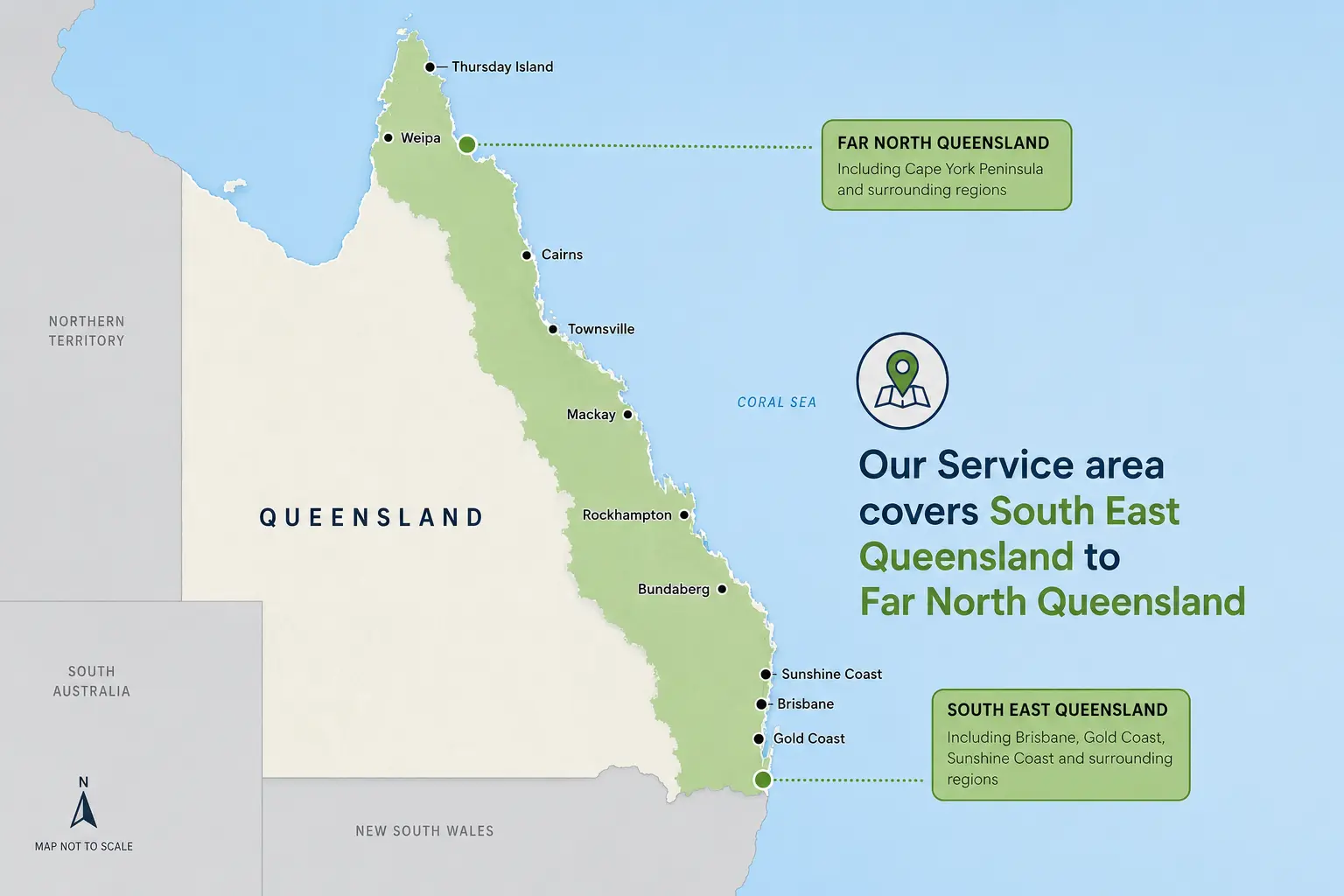
Areas we service are Sunshine Coast, Brisbane, Gold Coast, Wide Bay, Hervey Bay,
Bundaberg, North Brisbane, Ipswich, Toowoomba, South Brisbane, Tweed, New South
Wales, Victoria, Northern Territory, Western Australia, North Queensland, Central
Queensland, Cairns, Townsville, Rockhampton, Mackay
Ring us today for a free no obligation quotation
Safety on Ladders
In May, a worker sustained significant injuries after falling from a ladder. Early investigations indicate he was assisting with the installation of roofing sheets on a house renovation. For reasons yet to be established, the worker fell from the ladder suffering fractured ribs, a scratched diaphragm and other injuries.
Investigations are continuing.
IMPORTANT
These findings are not yet confirmed, and investigations are continuing into the exact cause.
Safety issues
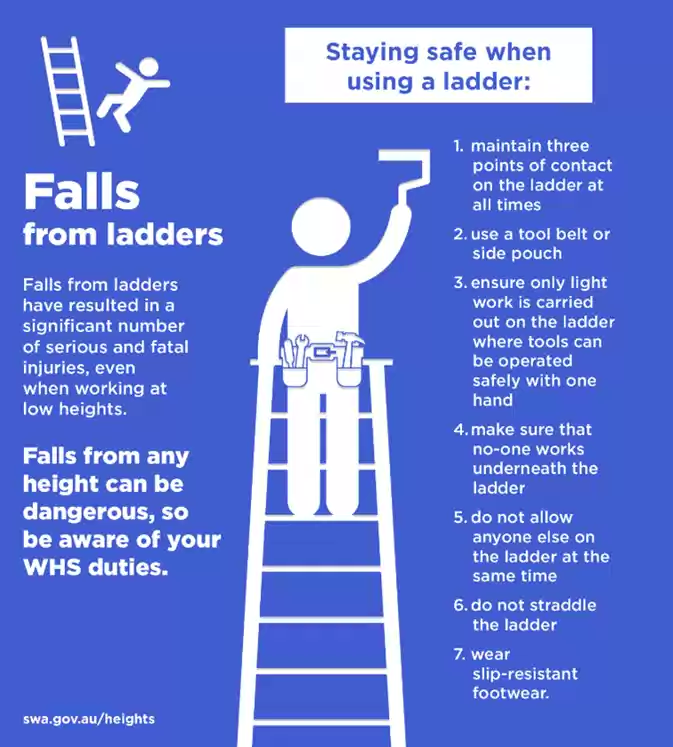
There are fall hazards in many workplaces, especially where work is carried out at height. The risk of falling is common in construction but may also occur in other industries. Falls from ladders have resulted in many serious and fatal injuries, even when working at low heights. In managing the risk of falls, the Work Health and Safety Regulation 2011 requires specific control measures to be implemented, where it is reasonably practicable to do so.
Work involving ladders often leads to falls because of:
- ladder stability
- moving on or off the ladder
- the type of work
- the person leaning out to the side of the ladder.
Ways to manage health and safety
Ways to manage health and safety
Taking steps to manage risks is a condition of doing business in Queensland. Effective risk management starts with a commitment to health and safety from those who manage the business. If an incident occurs, you’ll need to show the regulator that you’ve used an effective risk management process. This responsibility is covered by your primary duty of care in the Work Health and Safety Act 2011.
Use the hierarchy of controls to help decide how to eliminate and reduce risks in your place of work. The hierarchy of controls ranks types of control methods from the highest level of protection and reliability to the lowest. It’s a step-by-step approach to eliminating or reducing risks. You must work through the hierarchy of controls when managing risks, with the aim of eliminating the hazard, which is the most effective control.
When preparing a SWMS the following must be taken into account:
- the circumstance at the workplace that may affect the way in which the highrisk construction work is carried out
- on a construction project, the WHS management plan prepared by the principal contractor.
#identify the work that is high risk construction work
#specify hazards relating to the high risk construction work and risks to health and safety associated with those hazards
#describe the measures to be implemented to control the risks
#describe how the control measures are to be implemented, monitored and reviewed.
A SWMS should also include the following information:
- the PCBU’s name, address and ABN (if they have one)
- details of the person(s) responsible for ensuring implementation, monitoring and compliance with the SWMS
- if the work is being carried out at a construction project:
#the name of the principal contractor
# the address where the high risk construction work will be carried out
# the date the SWMS was prepared and the date it was provided to the principal contractor
#the review date (if any).
A SWMS may also include:
- the names of workers that have been consulted on the content of the SWMS
- the date the consultation occurred
- the signature of each worker acknowledging their participation in this consultation and the opportunity to discuss the proposed measures.
The content of a SWMS should provide clear direction on the control measures to be implemented. There should be no statements that require a decision to be made by supervisors or workers. For example, the statement ‘use appropriate PPE’ does not detail the control measures. The control measures should be clearly specified.
Workers and their health and safety representatives should be consulted in the preparation of the SWMS. If there are no workers engaged at the planning stage, consultation should occur with workers when the SWMS is first made available to workers for example, during induction training, or when it is reviewed such as during workplace-specific training or a toolbox talk. For more information on developing a SWMS, see the template located in appendix B of the Working safely in the house relocation industry guide.
Possible control measures to prevent similar incidents
Although a risk management approach must be used to manage the risks of falls from heights, there are several regulatory provisions that business owners must comply with in different workplaces.
All workplaces
Part 4.4 of the Work Health and Safety Regulation 2011 – Falls and the Managing the risk of falls at workplaces code of practice 2021 (PDF, 3.9 MB).
Construction work
Section 291 of the Work Health and Safety Regulation 2011 identifies high risk construction work as work that – (a) involves a risk of a person falling more than 2m.
Section 299(1) of the Work Health and Safety Regulation 2011 requires that before high risk construction work commences a safe work method statement for the proposed work must be prepared.
Subdivisions 2 and 3 of Chapter 6 of the Work Health and Safety Regulation 2011 give specific requirements to control the risks of falls, the use of ladders and platforms supported by ladders used during construction work.
Hazards associated with working at height (where ladders may be used) that involve a risk of falling must be identified. The following control methods should be considered when working at height:
- substituting the hazard causing the risk with something of lesser risk
- for example – using an elevating work platform so workers can avoid standing on a ladder to perform the task
- where regular access is required, consider fixed access systems such as stairways and platforms
- implementing engineering controls
- for example – a travel restraint or fall-arrest system with adequate anchorage points.
Administrative controls are then used to minimise any residual risk. For example:
- implementing a safe system of work that considers:
- the design
- condition and layout of elevated work areas, including the distance of a potential fall and the load rating of the structure (ladders)
- correct setup, stability and security of ladders
- only light duty work is done using ladders, where three points of contact can by maintained and tools can be operated safely with one hand
- implementing safe systems for a travel restraint or fall-arrest system including the provision of adequate training, instruction and supervision in how to use them and in the emergency and rescue procedure should someone fall
- workers have been provided appropriate information and training to perform the task safely (young, new or inexperienced workers may be unfamiliar with a task).
If a risk remains, it must be minimised so far as reasonably practicable by using personal protective equipment (PPE). For example, wearing slip-resistant footwear and using a tool belt or side pouch.
Administrative control measures and PPE rely on human behaviour and supervision, and used on their own, tend to be least effective in minimising risks.
Identifying hazards
in the workplace
Identifying, examining and preventing risks
& workplace hazards
OFFICE: 5/127 Sugar Rd, Alexandra Headland QLD 4572
Our Service area covers South East Queensland to Far North Queensland